Publications

Design Patents Enter the Virtual World: USPTO Expands Protection to Projections, Holograms, and Virtual/Augmented Reality Interfaces
As visual displays move beyond the flat screen into projected interfaces, holograms, and virtual and augmented reality environments, the U.S. Patent and Trademark Office (USPTO) has moved with it. On March 13, 2026, the USPTO issued a Supplemental Guidance that, for the first time, expressly recognizes these emerging display technologies as eligible for design patent protection.[1] The Supplemental Guidance also relaxes longstanding requirements that had hindered applicants seeking protection for computer-displayed interfaces and icons, which were previously deemed to not satisfy the “article of manufacture” requirement. Together, these changes represent a significant expansion of the design patent landscape for stakeholders in numerous technical fields.
Projections, Holograms, and VR/AR Interfaces Expressly Recognized. While water and electronics don’t typically mix, the USPTO nonetheless drew upon In re Hruby,[2] a 1967 case holding that the portion of a water fountain composed entirely of water droplets in motion constitutes an “article of manufacture.” The USPTO has now further relaxed the “article of manufacture” requirement to permit patenting projected or holographic digital displays, in part by analogizing the water shapes of In re Hruby to digitally-produced light shapes generated by electronic displays.
Under this relaxed requirement, visual displays, such as projections, holograms, and other virtual and augmented reality interfaces or icons are now protectable by design patents. The critical requirement is that the design be “for” a computer, computer display, or computer system, such that it is more than a transient or disembodied picture or three-dimensional image. This express recognition opens a significant new avenue for design patent protection for interfaces which exist beyond the boundaries of traditional display panels.
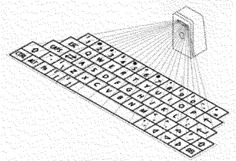
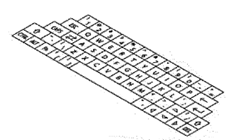
The Supplemental Guidance gives some examples including the two excerpted below. Not only is the projected keyboard interface with emitter (left) now protectable as a design, but the projected keyboard itself (right) is protectable.
Display Panel No Longer Required in Drawings. Prior to the Supplemental Guidance, the USPTO allowed design protection for computer generated images, icons, and the like, so long as they are displayable on a conventional display panel such as a computer monitor or phone screen, and were shown as such in the design application. Under the prior standard, Examiners were to reject a claimed design if the drawing did not depict a display panel or a portion thereof in either solid or broken lines framing or surrounding the claimed design. The Supplemental Guidance eliminates this requirement. The depiction of a display screen or a portion thereof is no longer required when both the title and claim properly identify the underlying article of manufacture, e.g., a computer, a computer system, or a computer display panel.
Importantly, the Supplemental Guidance does not dispense with the fundamental requirement that a claimed design amount to more than a transient or disembodied picture or three-dimensional image. The design must still be “for” an article of manufacture.
Looking Ahead
The Supplemental Guidance reflects a leap forward for design patent protection in the electronic age. With projections, holograms, and VR/AR interfaces now expressly within the scope of patentable design subject matter, and with relaxed drawing and claim-drafting requirements, companies developing next-generation user experiences have a powerful tool at their disposal. Now, comprehensive IP strategies are able to leverage design patent protection for graphical user interfaces, icons, projected displays, and other digital design assets.
[1] Supplemental Guidance for Examination of Design Patent Applications Related to Computer-Generated Interfaces and Icons, 91 Fed. Reg. 12394 (Mar. 13, 2026) – https://www.federalregister.gov/documents/2026/03/13/2026-04987/supplemental-guidance-for-examination-of-design-patent-applications-related-to-computer-generated
[2] In re Hruby, 373 F.2d 997 (C.C.P.A. 1967).