Publications

Expediting U.S. Patent Prosecution to Guide Foreign Filing Strategies
There are several reasons why a patent applicant might want to expedite the application process. An applicant might want to have an issued patent as soon as possible in view of competitors and actual or anticipated infringers. On the business-focused side, a U.S. patent may also significantly impact capitalization, including attracting investments and justifying corporate valuation, due to the validating effect of an issued patent on a business’ viability.
However, there are also important global patent portfolio strategy and timing considerations, including obtaining an early read on patentability in the important U.S. market before investing significant resources pursuing foreign patent filings. Relatedly, a U.S. patent, if issued early, may provide persuasive value and leverage to expedite prosecution in counterpart foreign patent applications.
Getting an Early Read on Patentability
The following patent filing strategy was successfully used in a case involving an applicant in the biotech area where the USPTO’s Track One Prioritized Examination program was used to expedite prosecution to obtain an early read on patentability and guide a foreign patent filing strategy. [1] [2] Figure 1 is a representative timeline showing key events from the filing of a U.S. provisional patent application at “time zero” to the ultimate 30-month national stage foreign filing deadline at which time expensive filing decisions must be made.
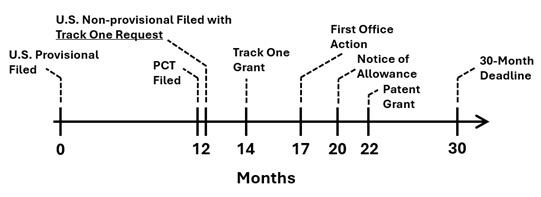
Figure 1. Timeline of Track One Prioritized Examination events in the case discussed herein.
As with many U.S.-based patent families, a U.S. provisional patent application was initially filed. A PCT international patent application was then filed 12 months later prior to the automatic expiration of the provisional application claiming priority thereto. The PCT application was filed to preserve both US and foreign filing rights, providing the standard option to wait an additional 18 months (i.e., at the 30-month national stage deadline) before filing a U.S. nonprovisional application and foreign patent applications.[3] Despite the higher overall cost of a PCT application compared with individual target country filings, a PCT application conserves significant cash flow by delaying the costly U.S. and foreign filings by about 18 months.
In our experience, foreign filings (inclusive of translation costs where applicable) may cost in the range of $10K per country for a sizeable application, particularly in the biotech field. This cost is merely to file the application and does not include future prosecution costs. These filings are therefore a significant investment, particularly for smaller or start-up ventures. Several factors may come into play, including the importance or value of the technology, how it would be commercialized, and what expectations investors or partners would have regarding their foreign filing strategy. Additionally, known prior art from patent searches is often considered to assess the chances of patentability. However, despite diligent consideration of these factors, the investment in foreign filings typically precedes concrete indicators of potential patentability from the various Patent Offices.
It may therefore be advantageous for a patent applicant to obtain some indication of allowability of the patent claims before the foreign filings are made. One option is to utilize Chapter II of the PCT process by filing a Demand for International Preliminary Examination. While PCT Chapter II results in a preliminary examination which may indicate allowability of the claims, the examination results are non-binding and ultimately subject to further search and review by the various Patent Offices. Alternatively, following the strategy discussed herein utilizing the Track One Prioritized Examination program, it is readily possible to go through at least one round of actual prosecution before the U.S. Patent Office to obtain a valuable read on patentability and potentially obtain an issued patent before the 30-month foreign filing deadline.
The biotech patent applicant decided to file a U.S. non-provisional application shortly after the PCT filing as a continuation of the pending PCT application. The Track One request was granted within about two months, and a first Office Action was received about three months after the Track One grant. The first Office Action indicated that key claims aligning with the patent applicant’s business strategy were in condition for allowance. An amendment and response was promptly filed resulting in a notice of allowance three months later. The issue fee was promptly paid and the patent issued about two months later.
In this particular case, the applicant was awarded an issued U.S. patent eight months before the 30-month foreign filing deadline. This allowance from the Track One route provided significant time for internal discussion and decisions utilizing the U.S. issuance as an early read on the patentability of key claims.[4] Based on this early read on patentability, the applicant was equipped to make the expensive foreign filing decisions with a higher degree of confidence than is typically available at this stage.
Conclusion
In view of the current USPTO examination backlog, patent applicants should carefully consider and discuss business and timing goals with their patent counsel from the start. With appropriate guidance, the current patent application backlog (which is likely to persist for several more years, even as it is incrementally reduced) can be strategically navigated. As seen from the actual case discussed here, Applicants should consider taking advantage of available expediting initiatives such as the USPTO’s Track One program to guide their foreign filing and business development strategies.[5]
[1]USPTO’s Prioritized Patent Examination Program, https://www.uspto.gov/patents/initiatives/usptos-prioritized-patent-examination-program. The “Track One” petition is technically not guaranteed and subject to USPTO discretion. We have never had a Track One petition denied, and all have been granted within about 3 months. Under the timeline discussed herein, the Track One request must be filed at the time of filing of the non-provisional application.
[2] Currently, the USPTO accepts 20,000 requests per fiscal year. As long as this quota has not been exceeded, applicants may pay a fee (currently, about $2,000 for a small entity, or about $4800 for a large entity) to cut the time to first action to a mere three months after grant of the track one request based on current statistics which encompass all technology areas. Among other requirements, the application is limited to no more than three independent claims and 30 total claims, which we find is quite adequate for most inventions. In addition to the reduced time to first action, Track One aims to reach a final disposition (allowance or final rejection) within one year after petition grant, meaning that intervening actions are accelerated as well.
[3] Note that the national stage deadline is currently either 30 or 31 months for most major filing targets. See www.wipo.int/en/web/pct-system/texts/time_limits.
[4] It should be noted that while a U.S. patent carries a statutory presumption of validity, the issuance of a patent does not guarantee that the issued claims are patentable under U.S. law, nor does it guarantee patentability under differing foreign patentability requirements.
[5] While this article sets out potential considerations for patent applicants vis-à-vis prosecution timing, the timing of actions made on a pending patent application are ultimately subject to exclusive control by the USPTO and may vary. While our actual experiences tend to align with the views expressed herein, there is never a guarantee of a specific timing outcome.